
On a hot day you have to eat an ice cream fast before it melts. If that happens to you, you lose a few rupees. If it happens to a truck carrying 20 tonnes of ice cream, the manufacturer can lose tens of thousands of dollars. This is how an IoT temperature sensor prevents that.
Results at a glance
- 50 refrigerated trucks monitored on HAZER
- 60% savings from prevented spoilage
- 35% lower labour and transport costs
The challenge
One of the largest ice cream manufacturers delivers to shops in refrigerated trucks, deep-frozen at -25 to -30 °C to keep the texture and flavour intact. If the refrigeration unit fails, or a driver switches it off to save fuel, the temperature can climb towards 35 °C within hours. Ice cream that melts and refreezes cannot be sold, and can even be unsafe. Manufacturers, carriers and retailers all need proof that the cold chain held.
The solution
KLOUDIP connected the fleet to HAZER, its IoT platform, to answer three questions at once:
- What is happening? Alerts for temperature changes and their cause: a failed unit, a unit switched off, an open door or a changed setting.
- Where? The truck's location, so the response fits the situation.
- Who? The driver at the wheel, with a phone number to call.
How it works
- Tracking. Every refrigerated truck reports to the fleet system, with live position and one-click access to cargo conditions.
- Temperature. Each truck carries IoT temperature sensors that report to HAZER. A breach triggers an instant alert, and the history is kept in reports and charts.
- Drivers. Drivers are assigned to vehicles, so dispatchers always know whom to call.
- Routes. Routes to every shop are optimised automatically, with alerts for early and late arrivals.
- Route control. An unplanned stop or detour can mean theft or delay; dispatchers are alerted and bring the truck back on route.
- A control centre on every screen. Each sensor is a widget, green by default and red when the temperature breaks its limit, with an alarm to the dispatcher.
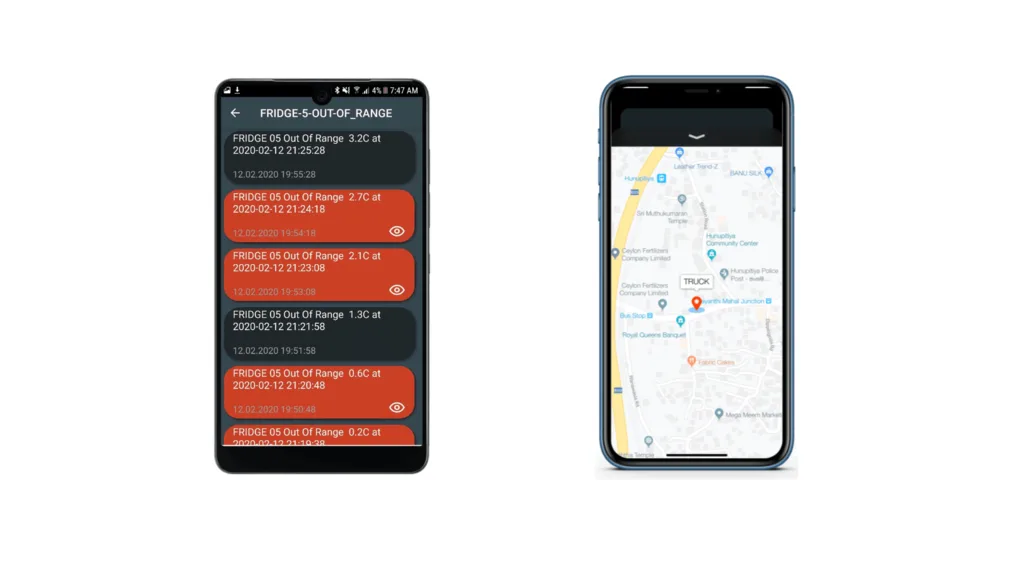
Temperature alerts on mobile
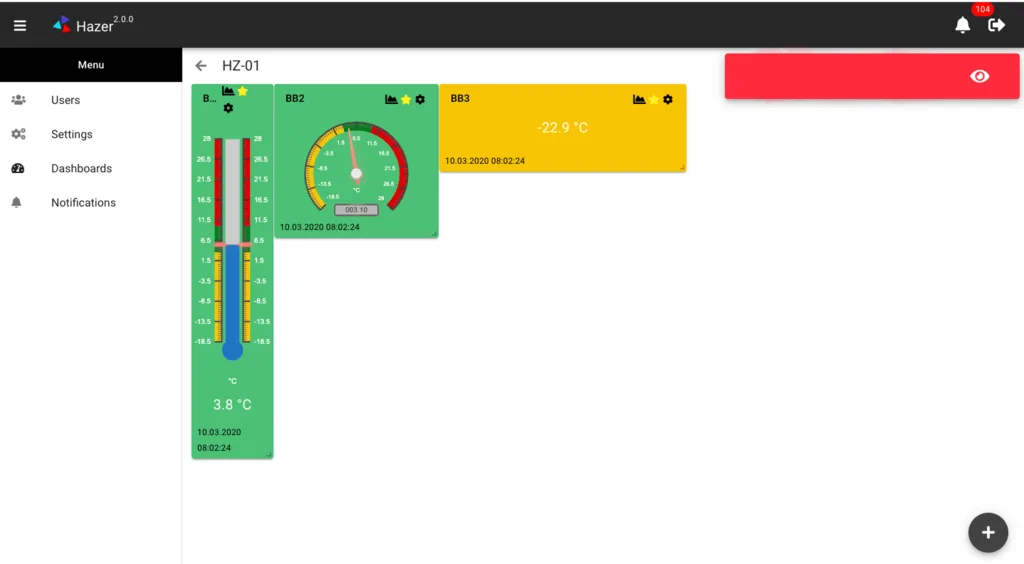
Temperature control centre
KLOUDIP went further, with separate sensors for different compartments and containers, each with its own temperature range and assigned to the dispatcher responsible for that type of goods.
The results
The manufacturer now monitors 50 refrigerated trucks on HAZER. Sanjeeva Cooray of KLOUDIP summed up the outcome: the company saved 60% by preventing spoilage and cut labour and transport costs by 35%. Re-deliveries, returns, and spoiled or stolen cargo are now rare. So next time you enjoy an ice cream, spare a thought for the sensors that kept it frozen all the way to your freezer.
Frequently asked questions
How is temperature monitored in a refrigerated truck?
Wireless sensors inside the cargo area send readings to HAZER through the vehicle tracker. Dispatchers see live values and get alerts when a limit is broken.
Can different compartments have different temperature limits?
Yes. Each sensor can have its own range and its own responsible dispatcher.
Can we prove the cold chain to customers?
Yes. HAZER keeps the full temperature history for each trip in reports and charts.
Talk to us
Make, store or move temperature-sensitive products? Let us show you how to keep them in range. Contact KLOUDIP
First published on KLOUD LIVE in September 2020. Updated and revised in November 2026.